Showing posts with label new soviet man. Show all posts

Friday, March 04, 2022

studying russian at the wrong time

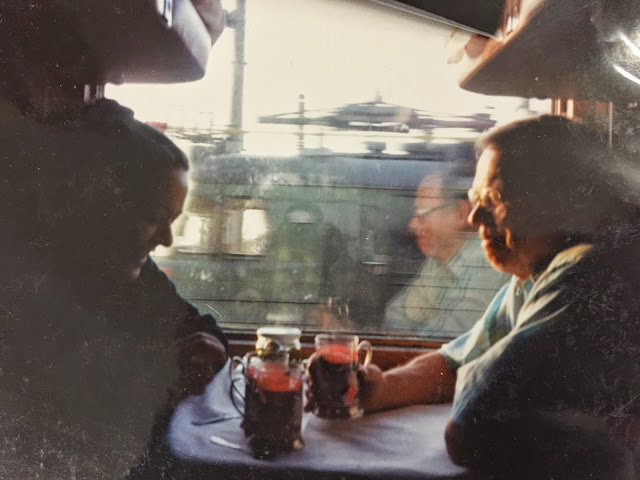
on the train from moscow to kazan with my dad in 1994

the past week or so of russia's agression against ukraine has me pondering my past. i studied russian, mostly literature and quite a lot of russian history. of course i studied the language as well, but i was never a great talent. i could always read it better than i could speak it. but i did ok, and most importantly, i loved it. 

i studied russian at precisely the wrong time to actually get to do anything with it. i began studying in 1989, just as the berlin wall fell. it took a couple more years for the soviet union to dissolve, but dissolve it did. and by the time i finished my bachelor's degree in 1993 and my master's in 1994, academia didn't really know what to do with us russian majors. 

looking back, so many of my professors were former military, harry had been to the defense language institute in monterey and then princeton (possibly not in that order). the head of our department at iowa, ray, was also former military, as was kit, whose last name i don't remember, though polish was his specialty. later, at asu, the head of the russian department was also former military. they were surely all tapping people on the shoulder to join the cia or fbi or nsa. but that tap never came for me. perhaps because of the aforementioned not being a language talent, but i think it had even more to do with timing. i simply studied russian at the wrong time. fellowships dried up. slavic departments shrank and merged with other "minor" languages. i met a nice danish boy and followed him home and love sent me in another direction.

and i believe that today, we're seeing the result of that. putin and his cronies felt humiliated at the dissolution of the soviet union and now he's taking the first steps towards getting it back. and because no one kept studying russian and slavic culture, it seems like the world is rather blindsided by it all. maybe they should have tapped some of us on the shoulder after all, even if we weren't brilliant at russian, but just had a deep and abiding interest in it and the culture. 

as usual, at moments like this, i wish i could still sit across from my dad and ask him what he thinks about it all. 

Thursday, July 12, 2012

soviet revolutionary textiles

mechanization of the red army
electrification
women harvesting
collectivization
celebrating the navy

young pioneers
tractors
airplanes
the ussr
gears
i already wrote about this once, but i'm not done being infatuated with the political textiles that were produced in the early years of the soviet union. it may have all gone wrong, but at least they believed in something. i despair a little bit that we believe in anything at all anymore. we certainly can't believe in our politicians and institutions. so we might as well believe in fabric.

Friday, June 29, 2012

a plan of monumental propaganda


the decade after the russian revolution in 1917 was a time when fabric served a political purpose. it was also the silver age in russian culture and so artists responded with enthusiasm to the call to create a political, functional art. the constructivists embraced the ideology that "clothing must present the soviet man and woman as part of an international community, that it must connect them with industrial civilization and that it must symbolize emancipation and mobility" (john e. bowit, revolutionary textile design).


this manifested in designs that were devoid of traditional, local, ethnic images, that used geometrical, mechanical motifs and featured kinetic forms.


they proved not to be as popular as traditional designs with the public, especially when they moved towards agitprop (agitational propaganda). the people just didn't take to flowers with gears or scientific-looking molecular blobs or winged wheels, however subtle they were.


but there's something appealing about the notion of textiles as political statements. and i don't see much of the political in the textiles of today - pretty patterns and whimsical motifs, yes, but politics, not so much. it strikes me that the use of organic cotton is the most political statement we get today in fabric form.


i think we could use a bit more subtle propaganda (and possibly fewer owls and vespas) in our fabrics. especially with services like spoonflower, where fabric design has become quite democratic and accessible for all. we should be making a statement, standing up for something in the very threads we clothe ourselves with.


bring on the fiber agitprop.

Wednesday, May 13, 2009

set in stone

back on may 1, which turned out to be a holiday and i was stuck in norway because That Girl booked my tickets all wrong, i used my time wisely and went to the wonderful Vigeland Park in the center of the city. it features 200+ bronze and granite statues, all done by Gustav Vigeland (at least the the clay originals--craftsmen actually did the carving and casting) in the early part of the 20th century.

for me, many of them had the larger-than-life feel of the depictions of New Soviet Man and Woman prevalent in the same period in the early soviet union. i'm sure there are many who would balk at that description, looking back as we do through the distorted lens of history, but i do think there's something of it in some of the work. but perhaps even the soviet sculptors were capturing a general zeitgeist.

most fascinating to me were the depictions of children together with their parents (presumably that's who those adults were). they are at once frozen and yet there is a sense of movement in them, like maybe you just blinked at the wrong moment and missed it, but it's still lingering in the air.


it was a gorgeous spring day and the sculpture provoked many thoughts that day. there's just something about good sculpture--it's at once static and moving, solid yet fluid, warm and lifelike yet cold. when it's really good, it captures the dynamic of life--the dichotomies and opposites present in us all.

i think that's what speaks to you from good sculpture..although it's quite literally set in stone, there is life and movement and fluidity.  there's that sense that if you blink you'll miss the movement. i feel it reminding me to be ever watchful, not to miss a thing--in life as in sculpture. to try to capture the moments and hold them in memory, although memory is more porous than stone or bronze, it doesn't really stop us from trying does it?

note:  if you're thinking that i skipped the monolith, which is perhaps the most famous one, you're right, but i'm saving it for another post.